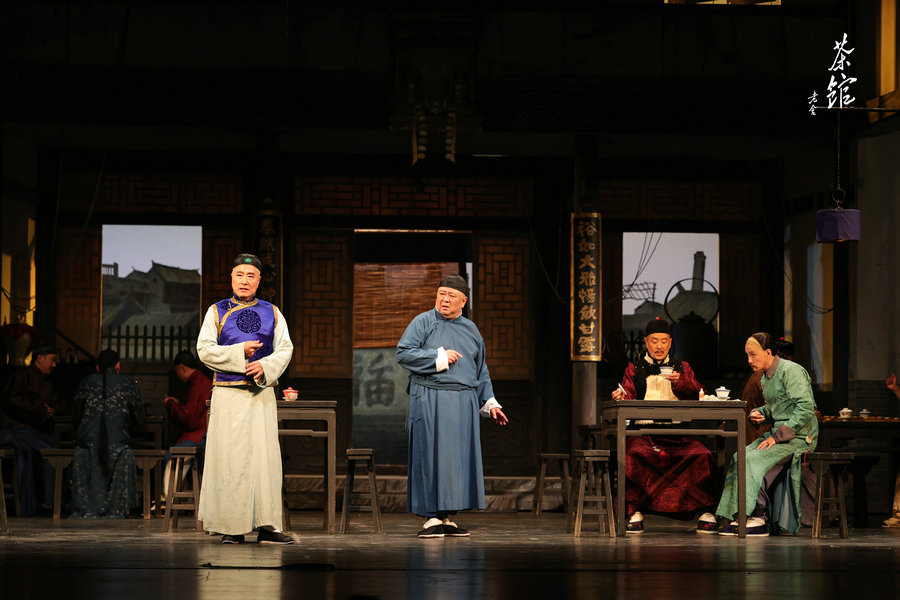
Teahouse (play)
Overview
"Teahouse" is a renowned play written by the celebrated Chinese novelist and playwright Lao She, whose real name was Shu Qingchun. Widely considered one of the most influential figures in 20th-century Chinese literature, Lao She's works often reflect the social realities and transformations of Chinese society. Teahouse, in particular, has gained significant prominence and remains a classic in Chinese theater, especially in the repertoire of the Beijing People's Art Theater.
Plot and Themes
The story of Teahouse takes place in Beijing and presents a vivid depiction of people and life during the late Qing Dynasty (1644-1911). It meticulously portrays the lives and struggles of ordinary Chinese people against the backdrop of significant political and social upheavals. The teahouse serves as a microcosm of Chinese society, capturing the essence of the changing epochs through the interactions of its diverse patrons, including businessmen, politicians, soldiers, and commoners.
The narrative structure of "Teahouse" is divided into three acts, each representing a different historical period. Through these acts, Lao She explores themes such as social inequality, the impact of political change on individuals, and the enduring spirit of the Chinese populace. The play is noted for its realistic depiction of characters and dialogue, offering a poignant commentary on the human condition.
Historical and Cultural Significance
"Teahouse" is more than just a play; it is a cultural artifact that provides insight into the historical transformations of Chinese society. Lao She, through his vivid and nuanced storytelling, captures the essence of old Beijing, with its bustling marketplaces, traditional customs, and the intricate relationships among its inhabitants. The play also highlights the resilience and adaptability of the Chinese people in the face of persistent challenges and changes.
The enduring appeal of "Teahouse" lies in its ability to resonate with audiences across different eras. It serves as both a historical record and a reflection on the complexities of social change. The play is often credited with influencing the development of modern Chinese theater by blending traditional storytelling techniques with contemporary themes.
Adaptations and Performances
Since its debut, "Teahouse" has been adapted and performed in various artistic forms, including stage productions, television dramas and films. The Beijing People's Art Theater, in particular, has played a pivotal role in popularizing the play, frequently staging it and preserving its legacy.
Influence on Chinese Theater
"Teahouse" is considered a cornerstone of modern Chinese theater, influencing generations of playwrights, directors and actors. Lao She's ability to weave social commentary into engaging narratives has set a standard for theatrical productions in China. The play's success has inspired many to explore similar themes of social change and human resilience, contributing to the evolution of theater in China.
The play's influence extends beyond its thematic contributions; it has also shaped performance styles and staging techniques in Chinese theater. The realistic portrayal of characters and settings in "Teahouse" has encouraged a move towards more naturalistic performances, emphasizing authenticity and emotional depth. Article reference1. Lao She International Theater Festival puts Beijing center stage. chinadaily.com.cn. 20182. Influential writer's work lives long in memory. chinadaily.com.cn. 2019Photo Gallery(5 pictures)CategoriesArtsTagTheaterCatalogue1. Overview2. Plot and Themes3. Historical and Cultural Significance4. Adaptations and Performances5. Influence on Chinese Theater- - - []








